
Stress potentiates decision biases: A stress induced deliberation-to-intuition (SIDI) model
Introduction
Stressful situations are not uncommon in everyday life, experienced for example by a doctor in the emergency room, a police officer in action, or a financial trader on a London trading floor. Individuals sometimes need to make important decisions when the stakes are high and when not enough information or cognitive resources are available to guarantee a sound choice. However, the high pressure may dramatically change decision making strategies, leading to different choices than would be made without such pressure. For example, individuals may approach situations differently depending on whether decisions are easy to make without far reaching consequences or life-altering and ambiguous. Although it is vital to understand decision making under stress, the majority of previous studies on decision making are carried out in non-stressful contexts. Only recent years have witnessed a remarkable burgeoning of decision-making research related to stress. But many findings in this field are mixed, leaving the specific effects of stress on judgment and decision making relatively unclear. The purpose of the current review is to summarize evidence from both human and animal studies on decisions under stress and to elucidate the neurobiological mechanisms underlying strategy shifting in the context of stress induced decision making.
Theories on decision making have proposed that there are two routes to making decisions: a fast route labeled System 1 and a slow route labeled System 2 (Kahneman, 2011, Evans, 2008, Gilovich et al., 2002, Evans and Stanovich, 2013). System 1 operates quickly and automatically with little effort. It activates our innate and instinctive responses to stimuli. For example, whenever a snake is detected or believed to be out there, instinctive fear is aroused and avoidance behavior is initiated without much thought. Such genetically hard-wired responses can enhance our ability to cope with vital environmental challenges of the type experienced during most of human history. Prolonged practice and experience also produce involuntary actions or habits. On the other hand, System 2 runs slowly and in an effortful manner, requiring complex computation. The pros and cons associated with each option are calculated and compared until an optimal choice can be made. Comparing both systems, System 2 is thought to be an evolutionarily more recent system and can flexibly check, modify, and override the decisions from System 1 (Tversky & Kahneman, 1983).
Although evidences showing that stress modulates decision making is accumulating (Starcke and Brand, 2012, Galvan and Rahdar, 2013, Morgado et al., 2015), there is currently no theoretical framework to explain why stress should influence decisions in certain ways. The evolutionary perspective on stress posits that the stress response has been shaped by natural selection to increase the ability of organisms to cope with situations that require action or defense (Cannon, 1914). When organisms are faced with possible damage or a loss of resources and a “fight-or-flight” response is required, they can express protective features that allow them to survive adverse conditions and help them mitigate the harmful effects of environmental stresses (Nesse & Young, 2000). For example, when under stress, organisms show increases in heart rate and contractility that speed circulation, increases in the rate and depth of breathing that speed gas exchange, increased sweating that cools the body and makes it slippery, increased glucose synthesis associated with spikes in energy, a shunt of blood from gut and skin to muscles, and greater muscle tension that increases strength and endurance (Graham, 1953).
Based on the evolutionary accounts of stress and the dual-system theories of judgment and decision making, it is reasonable to predict that stress promotes evolutionarily rooted intuitive responses in System 1. These intuitive responses are fast and require fewer cognitive resources to execute than in System 2. In normal situations, the intuition system may initiate some default action tendency and the reasoning system checks whether such a tendency is compatible with the current goals and environment. That is, intuition proposes first and reasoning decides whether to approve or to modify it. When under stress, the reasoning system may not check these response tendencies and instead allow individuals to rely on these rigid default actions in response to environmental challenges.
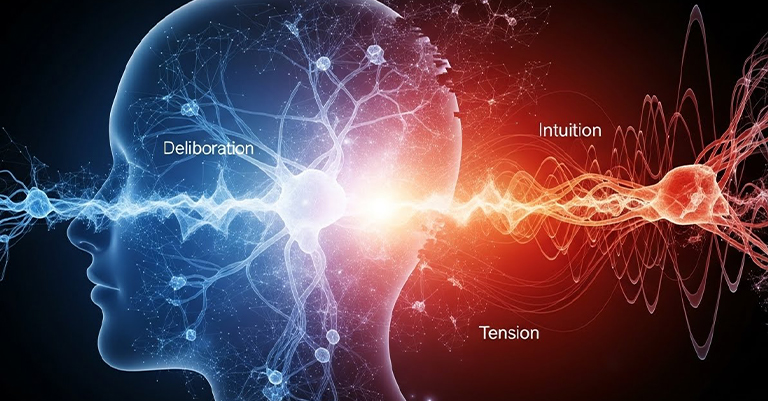
Grounded on this ‘intuition proposes, reasoning decides’ type of dual-system, I propose that when under stress, intuitive responses may bypass the examination of reasoning and reach the threshold to become final decisions. Thus, stressed individuals may fall back more on intuition and involve less amounts of conscious reasoning. Because they are intuitive, automatic processes ought to lead to premature choices, and stress may exacerbate decision biases via shifting decision strategies from deliberation to intuition, labeled as “stress induced deliberation-to-intuition” (SIDI). Intuition is a cognitive process that has multiple layers of meanings and implications. In the SIDI model, intuition refers to an automatic, habitual, and evolutionarily based decision making process, corresponding to System 1. Deliberation refers to System 2, which is a slow, goal-directed, and reasoning based process. This dual system account complements the previous theory that stress promotes a shift from flexible cognitive to rather rigid habit memory systems (Schwabe & Wolf, 2013). It is also consistent with the idea that stress impairs prefrontal cortex functions such as working memory and attention regulation, switching from thoughtful ‘top-down’ control by the PFC to ‘bottom-up’ control by the amygdala and related subcortical structures (Arnsten, 2009). Here, I extend these ideas by explicitly proposing that stress favors intuition versus reasoning in the decision making domain and thus leads to decision biases in some circumstances. The effects of stress on human behaviors are multifaceted (Staal, 2004), including long-term memory (Schwabe and Wolf, 2013, Schwabe et al., 2012, Joëls et al., 2006), working memory (Arnsten, 2009), and learning (Joëls et al., 2006). In this review, I focus only on the effect of stress on reward-based decision making in humans and discuss how the existing empirical findings support the SIDI hypothesis.
2. Stressors potentiate decision biases
Reward-based decision making refers to the process of examining reward magnitudes, probabilities, and risks, comparing options, and choosing a course of action. In the next section, I summarize the findings concerning stress and different decision making components, including the encoding of decision parameters (e.g. reward/punishment processing and risk analysis), executive control, and social decision making